A tenth anniversary Grand Prix, George Russell's first Grand Slam and a city that, for a few days, lives at full speed.
During Formula 1, Baku falls out of its usual rhythm. The city gets louder, faster and far more international. You hear the engines long before you see the track, and the boulevard fills with people in team colours. Very quickly you realise the race itself stopped being the only main event a long time ago.
2026 was a special year for Baku. It marked ten years of Formula 1 in the city, and in that time the Baku circuit has built a character of its own. It is nothing like a classic racetrack. Here the cars tear past the walls of the Old City, burst out of tight corners onto long straights, and a mistake of a few centimetres can change the whole race. That unpredictability is what sets Baku apart.
From the grandstand, a race feels nothing like it does on screen. First comes a rising roar, then a flash of colour, and the car is already gone around the corner. What stays is the vibration underfoot and the smell of hot rubber.
By Thursday evening it was already clear whose weekend this would be. George Russell was quickest in both practice sessions, and on Friday he took pole. On race day he simply never let anyone past. Every lap was his, and so was the fastest one. In Formula 1 that is called a Grand Slam, and it was the first of his career. It was also his first win in Baku, his third this season and his eighth overall.
Then came lap 36, and Baku reminded everyone why nobody relaxes here. Franco Colapinto arrived at Turn 1 with his wheels locked and slid straight into his own Alpine team-mate, Pierre Gasly. Gasly's car was thrown sideways into Lando Norris, and the McLaren hit the wall. Three cars, one corner, a few seconds. You could feel the whole grandstand inhale.
Everything slowed for a few laps behind the Safety Car. It did not get any kinder for McLaren. As soon as racing resumed, Oscar Piastri went wheel to wheel with Isack Hadjar for third, came into that same Turn 1 too fast and ran off the circuit. By the time he found his way back, he was 15th. Two McLarens, one afternoon, nothing to show for it.
The final laps were the kind you watch standing up. Max Verstappen appeared in Russell's mirrors and would not go away. Every time they flashed past, the gap looked smaller. Russell did not flinch. At the chequered flag, 0.196 seconds separated them. Less than a fifth of a second after 51 laps.
Hadjar brought his Red Bull home in third, so both Red Bull drivers stood on the podium together for the first time since China in 2024. Championship leader Kimi Antonelli, after a qualifying to forget, fought his way through the field to fifth.
Russell's name now joins a list of eight different winners on the streets of Baku. Only Sergio Perez and Max Verstappen have won here twice. Ten years in, "Expect the Unexpected" reads less like a slogan and more like a warning.
Look at Formula 1 only through the results, though, and you miss half the story. During the Grand Prix, Baku becomes a stage where sport meets music, travel and city culture.
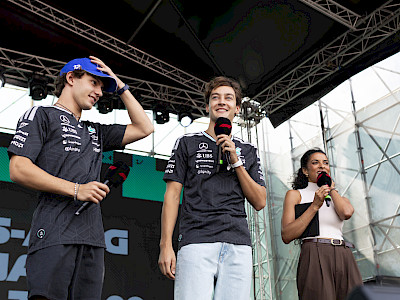
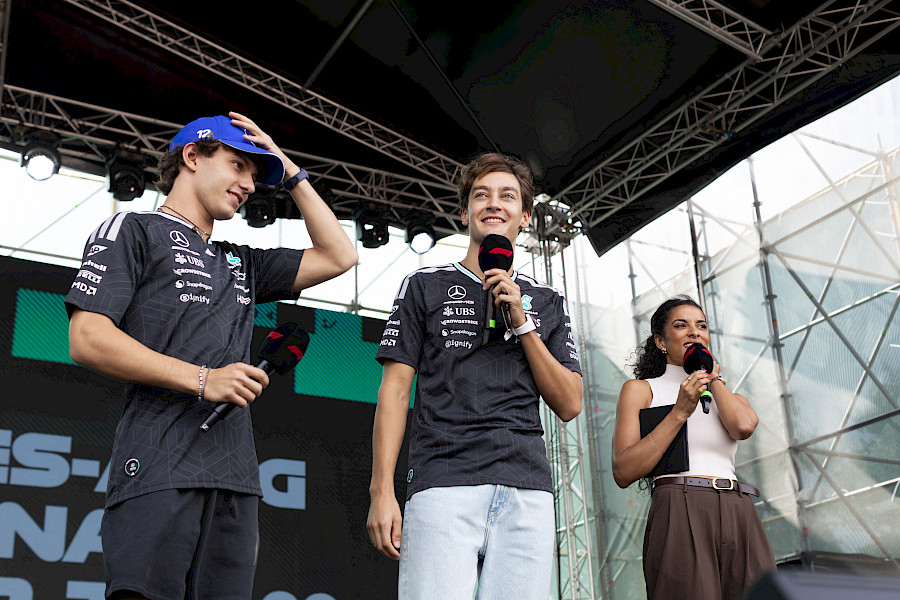
On the boulevard, the Fan Forum brought drivers from all 11 teams closer to fans than any race ever could. Max Verstappen, Charles Leclerc, Kimi Antonelli, George Russell, Lando Norris, Fernando Alonso and others took to the stage to talk to the crowd.
In the evening, the energy moved from the track to Baku Crystal Hall, where Calvin Harris and Katy Perry turned race week into a full city festival. After a day of engines, Baku carried on to the rhythm of music.
Just as striking is how Formula 1 shapes the image of the city itself. More than 17,000 international fans were able to watch the Formula 1 races live from the grandstands. For many of them, the trip was about more than the race. International journalists covering the Grand Prix visited the National Carpet Museum, learnt about the history of Azerbaijani carpet weaving and even tried the traditional technique with their own hands.
Perhaps that is the lasting impression of this anniversary race. Formula 1 in Baku has become much more than a few hours of racing. Behind those 51 laps are thousands of people who make the show possible. Around 2,000 volunteers help guests and keep the venues running, while 1,100 marshals look after safety on the track.
Ten years on, Baku has a Formula 1 of its own, with its own route, its own atmosphere and its own story. Here the race does not run somewhere outside the city. It runs straight through it. So when the engines fall silent, it feels as if all of Baku became part of one great racing world for a few days.