How many lighthouses are there in Azerbaijan?
Nine. Six are located on the mainland, while three are situated on islands. The lighthouse at the highest elevation is the Absheron Lighthouse, standing 101 metres above sea level, although the lighthouse itself is 25 metres tall. In our maritime sector, all lighthouses operate as part of an interconnected network – there is no single primary lighthouse. We have three lighthouses in the Baku area, and all of them remain fully operational. We have no decommissioned or abandoned lighthouses. In general, although the history of our lighthouses goes back a long way, none have fallen out of service. They are all regularly maintained, and any necessary repair work is carried out. The Azerbaijani sector of the Caspian Sea has the largest number of lighthouses. Our chain of lighthouses stretches from the Amburan Lighthouse in Nardaran all the way to the Astara Lighthouse. The principle behind the system is that if one lighthouse’s light is no longer visible, the light from the next lighthouse should already be in sight.
Do you live here at the lighthouse?
I have a house right next to the lighthouse. I have been living here for five years with my wife. All lighthouse keepers are provided with accommodation, so their spouses and children can live here as well. I have three children and four grandchildren. My daughter has moved away; my elder son is married and also works at sea, while my younger son is serving in the military. There have even been cases where children were born and raised at a lighthouse. We can also keep pets here. I have two dogs – Baron and Alma – and a cat named Duman that I’ve bought with me.
I always imagined that people lived inside the lighthouse itself…
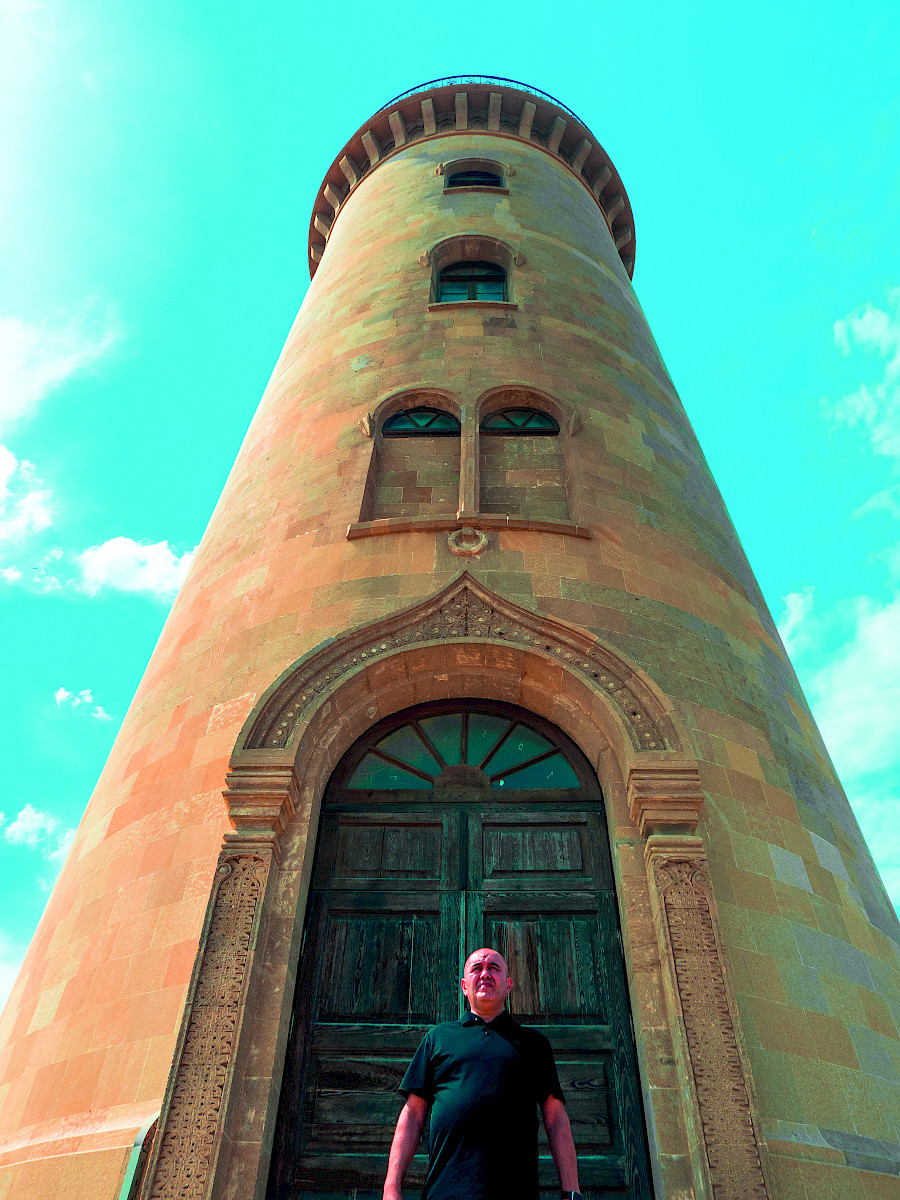
That is more common in other countries, but we have a few cases here as well. I don’t live inside the lighthouse myself, but at Shuvalan, Amburan, Chilov Island, and Lankaran, some lighthouse keepers do. At the Lankaran Lighthouse, there is also a separate keeper’s house next to the tower, but on Chilov Island and at the Shuvalan and Amburan lighthouses, families live inside the lighthouse itself. The building is designed so that the tower rises from the centre of the living quarters, with the staircase to the lantern running up through the house.
What does a typical day look like for you?
Lighthouse keepers’ days are much like anyone else’s at home. The difference is that our work revolves around the lighthouse. We make sure it is clean, functioning properly, and operating at all times. I don’t commute into the city – this is my workplace. There are set shifts, during which either the lighthouse technician or the head lighthouse keeper is on duty. The lighthouse has specific times when its light switches on and off, and these are automatically regulated according to sunrise and sunset. When the sun rises, the light goes out; when it sets, the light comes on. During those periods, we are always busy. When you look towards the shore from the sea, you will see countless yellow lights. The lighthouse stands out because its light flashes on and off in a distinctive pattern.
Throughout the day, we also look after the lighthouse grounds and the keeper’s house, making sure everything is clean and maintained. At least once a day, I climb to the top of the lighthouse to inspect it and check that everything is clean, although I don’t usually step out onto the balcony.
If any technical fault occurs, we immediately report it so that a Notice to Mariners can be issued informing vessels that the lighthouse is temporarily out of service. Someone always has to be here to detect any problems. We notify the relevant authorities, who then inform ships and the appropriate maritime organisations that the lighthouse has been taken out of service.
Have you experienced anything interesting or unusual during the five years you have been here?
I haven’t witnessed anything unusual myself, but there is an interesting story connected to this place. In 1857, the “Guba” ship sank here, and that tragedy led to the decision to build this lighthouse. The decision had actually been made earlier, in 1853, but construction was suspended because the Ministry of the Navy lacked the necessary funding. The lighthouse was eventually completed in 1860.
It was built under the administration of the Russian Empire, while the lantern was brought from France. Since there was no electricity at the
time, the lighthouse originally operated using kerosene lamps. One of its lamps was even brought from the Maiden Tower. It was electrified in 1956. The lighthouse underwent a major restoration in 2020. People used to say that the sea reached the rocks here. In recent years, however, the shoreline has receded by about one and a half to two metres.
What is the most difficult aspect of living at the lighthouse?
The hardest aspect is probably winter. It gets quite cold here, and it is very windy. Climbing up and down the lighthouse stairs can be difficult in those conditions. Winters are harsh because this is such an exposed, windswept location. The most frightening thing, though, is the waves.
It is much the same on the islands, except they are much farther away. For example, Sangi Mugan Island is about 80 kilometres from Baku. The keepers there change shifts only once a month, although supplies such as fresh water and fuel are delivered. But I really love this way of life. For me, it has nothing but advantages. It is quite peaceful here – I feel calm, my mind is at ease, and I truly enjoy living in this place. A lighthouse is widely regarded as a symbol of hope. Around the world, many countries and maritime organisations observe 7 August as Lighthouse Day, dedicated to lighthouse keepers and technicians who look after these navigational beacons.
Do you ever find yourself here alone? What has this solitary way of life taught you?
It has taught me to endure hardship. Out here, you are on your own and far removed from everything – far from civilisation. When I am alone at the lighthouse, I enjoy looking out at the sea, but I never actually feel lonely. When my wife is here with me, the sea has the same calming effect on her. It helps her relax and unwind. That said, we still go into the city at least every couple of days. As a family, we might go to a restaurant and have fish. I don’t enjoy fishing myself, though – it has never really interested me. But many people who work at sea are very fond of fishing. For a lot of them, it is something that helps them relax and find peace of mind.
How did you choose this occupation?
I served in the Navy, and after I retired, I was assigned to this lighthouse. It didn’t feel like stepping into something unfamiliar, as I had spent my career in maritime service. In many ways, this role was simply a continuation of that service.
How do you communicate with the ships that pass by?
We can’t communicate with them directly. A lighthouse simply provides a light to guide them. As ships pass, they identify this lighthouse by its light characteristics. Every lighthouse has its own unique flashing pattern. This one, for example, stays lit for three seconds and then goes dark for three seconds, so it flashes ten times a minute. From that pattern, a ship captain can identify exactly which lighthouse it is, the area they are in, and where they are along the coast. In foggy conditions, some lighthouses are also equipped with fog signals – audible warning signals – but this lighthouse doesn’t have one.
These waters can be hazardous. We can see the sea from here, but beneath the surface, there may be large rocks or other underwater obstacles. Today, ships are equipped with modern navigation technology and positioning systems. However, if those systems fail, that is when the lighthouse truly becomes what it is often called – a symbol of hope. Its light still enables mariners to determine their position and navigate safely.
Our world has become increasingly digital. Do you think computers and new technologies will eventually replace lighthouses – or even lighthouse keepers like you?
Technology has advanced enormously, and most ships now rely on GPS for navigation. But computers can never replace people. If a lamp stops working, someone still has to replace it.
From a technological perspective, lighthouses may become less essential for navigation, but, as I have said, they will remain as historical landmarks and enduring symbols of hope.
Do lighthouse keepers keep in touch with one another?
Yes. We usually get together once or twice a year. The keepers from all the lighthouses attend these meetings. We meet with the head of the lighthouse service to discuss our work, address any issues we are facing, and make plans for the future.
We also report on the work carried out over the course of the year and are briefed on the tasks and priorities for the period ahead.
Have you ever experienced anything truly frightening?
The waves are the most frightening thing at sea. For example, I have been out on the Black Sea, where the waves can reach 10 metres high. I have experienced real fear there. There is nothing you can do about it – you simply have to ride it out. You are stuck inside the ship and there is no way out. Whenever I am scared, I talk to the sea, saying, «Please let us make it through safely.»
How you ever seen aliens
No, I haven’t personally seen aliens or anything unusual at the sea.
Is it true that people who work at sea are initiated by drinking seawater?
Yes, it is. Anyone who goes out to sea for the first time drinks seawater as part of an initiation ritual. I went through the same tradition myself – I drank a glass of seawater.
Are there any nautical terms you use in your everyday life?
Yes, quite a few. We call the stairs used to board a ship the gangway and the ship’s kitchen the galley. Even after mariners come home from sea, they continue to use these nautical terms in their everyday lives. For quite some time, I even kept calling my kitchen the galley.
What message would you like to leave for our readers from the lighthouse?
I would like to ask people to love the sea, to keep it clean, and not to pollute it. The sea is a source of life. Just like people, the sea has a soul of its own. The more we pollute it, the more we destroy that life.
Do you see yourself as a man of the land or a man of the sea?
A man of the sea. Without a doubt.
FACTS
- Construction was completed in 1859, and the lighthouse was commissioned on 23 October 1860.
- The lighthouse stands on a high rocky cliff near the settlement of Gürgan on Pirallahi Island.
- It was designed to guide ships safely through the Absheron Strait, the channel between the mainland and Pirallahi Island.
- The lighthouse has witnessed more than 165 years of maritime history.
- Because of its elevated position, ships can spot the lighthouse’s light from up to 38 km away.